Is the increasing rate of technological change caused by human activity?
Something I wrote when I was 17 (all the way back in 2021!). A lot of truth to it ─ A lot of generalisations, but overall a decent piece of writing.
· 23 min read
TECHNOLOGICAL CHANGE affects everyone and provides a net positive towards the world. The fact that technological change is accelerating allows for rapid changes in society and the human population. The term ‘human activity’ involves how humans interact with the world, so this essay will analyse whether the actions of humans directly lead to increased technological change, or instead other factors play a larger role.
The term technological singularity refers to a moment in time in which the rate of technological change will ‘be irreversibly transformed’. This event is expected to occur within the coming decades, according to experts. (Kurzweil, 2005). This will result in rapid technological advancement. Whether this singularity is caused by human activity or natural means, can impact the future of advancements in technology.
Throughout history, we can see that technological advancements have been made at an increasing rate, such as the creation of human-flight around the end of the 19th century, which now has developed into the widespread launch of rockets containing celebrities into space (Amos, 2021). Technological development has contributed to the increase in innovation, the personal computer and the internet has allowed anyone to connect online and share their ideas across the world. A world before the PC was invented or even widespread is radically different to the modern world, in which there are nearly enough smartphones to give to everyone on Earth (O'Dea, 2021). The number of smartphones has almost doubled since 2015, which shows how technology has caused a large impact on society.
If the rate of technological change continues to increase, then many advancements that benefit humanity will be made. For instance, experiments have been carried out which can reverse some of the effects of ageing in mice. once this technology is improved and hence available for humans, then death by natural causes will plummet (Ledford, 2020). This will only occur if humankind continues to advance. The only way to ensure this is to find what causes this growth in the first place whether it is due to human activity or if it is an inevitable part of evolution. This essay will look at historical patterns and use data to predict the future in order to conclude what causes the technological change to increase. In addition, data can be used to predict the future of technology and find whether we will continue to experience this growth. Current and upcoming technology can assist humans in becoming a more advanced species, recent inventions such as Artificial Intelligence, can prove it.
If technology advancement is accelerating, then the future of the world would look unforeseeably advanced, known as the idea of the technological singularity, compared to the modern day. The question is: is it possible for technology to reach a singularity?
What new technologies will cause technological expansion?
The dawn of quantum computers allows for greater computational capacity, continuing the trends of ever-increasing performance. Quantum Computers promise to revolutionise the computer industry by using specialised algorithms to decrease the amount of time taken to complete processes. The number of items needed to be checked on average is n/2 for a traditional computer, and √n items using ‘Grover’s Search’ in quantum computers (IBM, n.d.). This will result in much higher efficiency when doing processes such as searching for items in lists. This new way of thinking to solve problems will allow computers to become better at running increasingly difficult algorithms.
Another example of technological growth is the agent created by DeepMind, called ‘MuZero’. This agent aims to master certain processes without being giving the rules of the problem. The reason for that is to potentially give the agent the ability to solve problems that we do not know the answer to, in the future, so Artificial Intelligence can have a larger impact on research (Schrittwieser, et al., 2020). MuZero is given the ability to plan ahead, which dramatically increases its performance and can master given problems faster than previous models.
The language model GPT-3 is getting closer to creating forms of text similar to humans. It has 175 billion parameters and marks a point in time when we are on the verge of Artificial General Intelligence that can replace the roles of all humans. The language model creates text to imitate humans and write essays for them, given a few keywords and subjects. It will then search the Internet using its 175 billion parameters looking for valid information and compiling it. Interest in AI is increasing, shown by Microsoft’s exclusive licensing of the model (Scott, 2020), which shows that these technologies will change how businesses operate. Microsoft is using the text generation to create their own software with advanced text creation which takes a description of the function of code and translates it into real code (Langston, 2021).
The Internet of Things is an idea which states that every device in our lives will eventually become connected to the internet. This comes around because of increasing demand on the internet on everything. Unconventional smart devices such as kettles are already in place, connecting all aspects of someone’s life to the Internet of Things.
The advances in computing technology show that we are advancing towards a singularity (shown by Moore’s Law) and modern innovations will assist in the technological growth (being MuZero and following AI creations, and GPT-3 and subsequent language generators). Since ground-breaking advancements are still being made, it can be assumed that there are still advancements to be made in the future, and we are not approaching some limit of progress, and complexity. All these inventions have been created by humans, and our innovation. However, are we just contributing to larger trends of increasing complexity?
The trends of history can show us a lot about the future. If we can determine that technology has been accelerating throughout human history, then it should continue to accelerate into the future (given that nothing changes).
History has been shaped by the various technological paradigms, which can be identified by the economies of the civilisations and the output of the workers of the country. The sectors include agricultural and raw material extraction, traditional manufacturing industry, services, and computational technology. They can each be split into according revolutions or paradigm shifts. Hence, the above can be separated into the Agrarian Revolution, Industrial Revolution, introduction of electricity, and the computer age. Each of these shifts have introduced a new key technology which is then used to create new innovations and make more discoveries.
Paradigm shifts can be measured by looking at the employment in each sector of the country. We can see that most workers in the USA and UK were employed in agriculture in the late 18th and early 19th century. After then the manufacturing industry, especially in the UK, took up a larger percentage of employment, corresponding with the industrial revolution. Then, the services sector grew substantially in the 20th century, with the introduction of new jobs. The service sector now contains the vast majority of jobs in both the economies of the USA and UK. Between 1995 and 2014, employment dropped ‘from 2.5% to 0.7% in agriculture and from 17% to 14% in manufacturing in the USA' (Makridakis, 2017). These numbers show that we are continuing to change the type of jobs available because of increased development. New technology allows certain jobs to be introduced, slowly increasing the skills required for each citizen (manual labour can be automated by machines, so people instead work in offices and finance, something not yet replaced by computers and artificial intelligence). It can be stated that the more technology a country has is linked to the types of jobs available (due to service jobs creating more value into the economy). The ranking of the country on the Human Development Index (HDI), is tied to the number of employees in each job sector. Regions with a higher HDI value tend to have the majority of jobs in the service sector, followed by the manufacturing sector, and then agricultural, whereas the opposite is true for less developed countries with a lesser HDI value (Szmigiera, 2021), (United Nations Development Programme, 2020). So, a transition between types of economy shows that a new technology potentially has been introduced, thus a change in employment sector can be associated with a shifting technological paradigm.
The amount of time since each of these paradigm shifts has been decreasing, reflecting how humans are becoming more advanced (Grinin, et al., n.d.). – Human achievements are become closer together because of centuries of increased knowledge. Grinin et al. splits the ‘production principles’ (hunter-gatherer, craft-agrarian, trade-industrial, scientific-cybernetic), into six distinct phases which defines how the production principle has progressed. By then writing the years which each of the phases occurred in each of the principles, they found that the length of the phases was decreasing at an accelerating rate, showing that we are progressing through different technological paradigms at an increasing rate, thus technological change is accelerating.
Grinin et al. states that world population correlates with ‘macro technological growth rate’. The higher the population, the more innovators there are in the world who can come up with a new idea. As human population skyrocketed in the last century, so has the amount of innovation (from the personal computer to aeroplanes).
It appears that humans and their achievements are not unique when being compared to the formation of life and evolution of complex organisms. Nature has managed to create structures which we do not fully understand (yet), somewhat randomly through evolution. The human brain was formed over millions of years of evolution, yet in a fraction of that time humans have managed to form sophisticated civilisations.
This stems from Kurzweil’s idea that when key historical points are plotted on a logarithmic plot with their year, with each unit on the scale corresponding to a 10x increase, a straight line is formed, showing constant acceleration. This is still seen on the graph when the data is taken from a group of independent experts. This graph shows that the time between events is decreasing as the events get closer to the present.
Figure 1
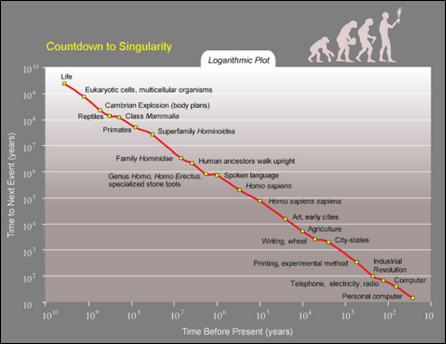
Countdown to singularity. Time to Next Event (years), logarithmic scale plotted against Time Before Present (years), logarithmic scale. (Kurzweil, 2005)
Therefore, there is a universal change in which the time between significant
events/discoveries is always decreasing. Using the evidence stated above, it points towards the acceleration of change being independent of human activity and their technological developments. Simply: it is not humans who have caused all these historical innovations (however impossible that may seem), but instead, the nature of the world and evolution has naturally always caused improvement and forward change. Before humanity, Earth was becoming increasingly complex, due to natural selection gradually refining life.
The time between these events has been decreasing since before humans have existed. Therefore, evolution must have been playing a role on the increasing complexity of the world, refining each lifeform, creating more advanced beings as time progresses. As humans emerged, the progress of evolution was slow, relative to the rate of advancements humans could make on their own (Evolution has not created an animal that can solve the same problems computers, created by humans, can). There will always be a point in time where a species outpaces evolution, as evolution causes the animals to improve and adapt to survive, therefore it is guaranteed that a species will have eventually evolved until wielding tools, and thus be able to develop societies. This can be shown by how other animals have developed the ability to use tools. The book ‘Animal Tool behaviour: The Use and Manufacture of Tools by animals’ outlines what is meant by tool usage (Shumaker, et al., 2011). New Caledonian crows have been identified creating tools in order to capture prey (Hunt & Gray, 2002). Therefore, other primates or apes could have taken the place of humans, eventually advancing like we did (if humans had never existed because there is complexity in Earth without humans).
Earlier, it was argued that technological growth has always been accelerating. Though it is true that as of recent (in the scope of the Earth), the acceleration has been caused by human actions, it is still the logical, natural next step that a species will develop that will be the world’s innovators. Evolution has caused human innovation and created their will to always improve, otherwise we would not have formed advanced civilisations, ending up like every other animal on this planet.
However, humans now have the ability to undo all progress (by climate disaster or nuclear war as the most probable candidates for the end of humanity), so it is clear that we have advanced past the threshold in which humans now are in control of their fate (whether technology will continue to progress). The Doomsday Clock is a concept which states how close the world is to destruction which is determined by a panel of experts. The clock is now at its closest point to midnight (doomsday) since it was founded in 1947. The likelihood of catastrophe has increased due to the increasing impact of humans on the planet, decreasing to 100 seconds to midnight in 2020. The greater the technological progress the more ways there are for an extinction event to occur. (Bulletin of the Atomic Scientists, 2020). Inventions such as the atomic bomb and more recently, Artificial Intelligence, have the power to destroy the world if they are placed in the wrong hands. As technology advances it becomes available to more people, increasing the probability of someone with malicious intent having access.
Figure 2
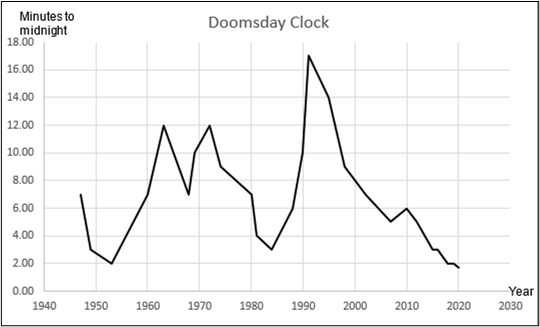
(Bulletin of the Atomic Scientists, 2020). This graph shows the time (minutes) until midnight according to the Doomsday Clock.
Humans have just been riding the wave of nature’s predictable patterns, allowing for them to become the dominant and most advanced species.
Using historical data, it can be argued that innovation is in fact increasing, despite short term decreases in innovation, the trends recent are pointing upwards. Jonathan Huebner argues that innovation is decreasing, looking at the data from the time, over a 10-year average, the number of patents filed per 106 people had been decreasing since 1915 (Huebner, 2005). However, the 10-year average on the x-axis hid the fact that the graph had, in fact, been steadily increasing from 1979 onwards. See Figure 3, on patents in the USA per 1M people.
Figure 3
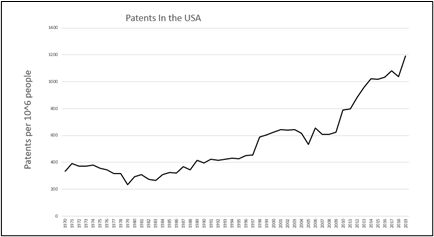
(Patent Technology Monitoring Team, 2020), (US Government, 2019).
This graph may not reflect global trends in innovation as the economy of the USA is only a small section of the world. This graph is adjusted to remove population change from affecting the number of patents in each year, the graph shows how per person, patents are increasing.
The increase in the number of patents means that corporations and individuals have been more innovative (introducing new ideas) (Merriam Webster, n.d.). More innovation means that new ideas are being created faster, therefore the number of patents utilising a new technology is increasing. This could show that the rate of technological advancements is increasing, as patents and innovation are linked. Additionally, the creation of new technology increases the number of patents, as there would be a new market which can be filled with new ideas and innovations. Once the Personal Computer was invented, companies wanted to create the next big thing, so they would experiment with unique ideas and uses for computers, trying to get a unique selling point. Whether this involves trying to develop the fastest and best hardware to outperform competitors or make a product marketed as a device that anyone can use (Apple). When companies compete, they need to continuously innovate their products/services so that they appear to be the best in the market in order to claim the largest market share. Therefore, a new technology results in a feedback loop as businesses will create products using the new technology, so there will be a new niche with many competitors. This will drive innovation and thus create greater technological advancements. This feedback loop can result in new technology being developed, repeating the cycle, compounding the changes in technology, resulting in year-on-year acceleration and rapid change of products in the markets. Figure 3 shows the decline of the number of patents in the USA from 1971 to 1983, however, they increase significantly after that point, this may be due to the Personal Computer and Internet technologies creating a new market to release new innovative products.
However, the number of patents is not directly linked to an increase in innovation - safe/unsubstantial patents could make up the majority (patents that provide no real change or might be in practicality useless). The ability to patent an idea/design is becoming more accessible, allowing people with low quality patents to boost the numbers, creating an illusion of innovation and growth. This fact is because people have a good patent idea if they are spending the effort filling out a physical form. For example, a patent was filed in 2000 about swinging sideways on a swing (Hecht, 2002), ‘by pulling alternately on one chain and then the other.’ (Olson, 2000). This patent was accepted in 2002 by the United States Patent and Trademark Office. It has been becoming easier to apply for patents, recently because the application process is available online, which could be the cause of the significant rise in patents since the end of the 20th century (figure 3).
‘[We] always use the latest technology to create the next: technologies build on themselves in an exponential manner… this acceleration and exponential growth applies to any process in which patterns of information evolve. So, we see acceleration in the pace of biological
evolution, and similar (but much faster) acceleration in technological evolution, which is
itself an outgrowth of biological evolution’ (Kurzweil, 2010). Kurzweil uses this fact to predict the future of Information Technology. Each technological advancement allows for more innovations and culminates in greater knowledge. The number of FLOPS (Floating-Point Operations Per Second), of the largest supercomputer each, is plotted with a straight line of direct proportion on a log axis (TOP500, 2021). Humans build greater supercomputers applying the knowledge they have learnt, resulting in a constant percentage increase in the improvement of the performance. The computational performance is linked to how advanced technology is because more powerful computers can solve more problems applicable to real life.
Technological growth is accelerating. Moore’s Law states that every two years, the number of transistors per unit of space doubles (Tardi, 2021). This effectively means that the performance of a Central Processing Unit (CPU) has been observed to double every two years, so the amount computational power available to the public is accelerating at a constant rate and has been for the past 56 years (Moore’s Law was created in 1965). Advancements made in computing have allowed for this continual improvement e.g., innovations made by chip manufacturers to decrease the size of a transistor. The fact that this concept continues to be true to this day, with computation speeds still accelerating shows that these predictions can be accurate and represent the growth of information technology, closely. Despite all the changes in the world since the 1950s, this law remains correct, assisting the theory that humans are continuing to innovate and come up with new ways to improve the performance of the Personal Computer without affecting the price.
The opinion of people on science has changed as technology has progressed. Is the opinion of people a factor which affects the amount of innovation that currently occurs? The Scientific Method has resulted in increased willingness for researchers to accept that their findings can be wrong (which used to be uncommon, as it was not acceptable to challenge the accepted theory). The Scientific method involves using evidence and creating a repeatable experiment in order to prove their hypothesis. This shift away from believing in theories from the past to challenging everything allowed for the dawn of the Scientific era in the early 19th century.
People are become increasingly willing to believe in science to solve a problem and better society compared to the Middle Ages. Science is becoming more accepted due to the following reasons: worldwide literacy rates are increasing and have been for over the past 100 years, with most developed countries being 100% literate (Our World in Data, 2015). Education is improving because each discovery made allows for a more complete picture of the world to be taught at schools in addition to students understanding the idea that technology and scientific theory is constantly adapting.
However, more openness to science might not cause an increase in technology, it might be the other way round that technological progress causes science to be deemed more trustworthy. People are more willing to accept scientific ideas because the benefits of science have been proven to radically improve people’s lives.
The following arguments provide reasons why technological growth could slow in the future due to human activity.
There is an idea that computers will stop improving as “Moore’s law is dead” which shows why the exponential trend in computational growth is coming to an end. Moore’s Law cannot continue indefinitely into the future because there is a limit to how small a microchip can get (the smallest size is in the nanometre range, due to physical limitations of the size of atoms). In addition, the temperature of computer chips has created a limit on how high the clock speed (number of calculations per second) can get – on average it has not increased since 2004 (Waldrop, 2016). If the temperature, exceeds a threshold the device will become impractical to use. Due to these facts, there could be a limit to CPU processing capabilities.
The distribution of mass misinformation spread via the internet, specifically social media, such as Facebook has caused people to trust strangers, and not science. This can be shown by the COVID pandemic, people spreading politically charged lies about vaccine effectiveness. 26% of American adults do not want the COVID-19 vaccine, despite the fact that it is effective and has been available to the public for almost a year (Mikulic, 2021). People are becoming less likely to trust science, ironically spreading their false agenda via machines created using technology. People not believing science and progress, will result in no more technological change and no willingness to innovate, so we could very well be reaching a point in which humans decide to become anti-technology. As a result, the rate of technological change will no longer increase. Only 32% of the members of public in the USA (2009) think that evolution was due to ‘natural processes’, even though 87% of scientists agree that human evolution is due to natural processes. (Pew Research Center, 2009). This lack of education and denial of facts shows that people think that they are smarter than scientists. Therefore, this fact means there is still a long way to go for people accept the science. According to the Pew Research Center, only 46% of Americans know that the electron is smaller than an atom. This lack of teaching can halt technological advancement as people will not be educated enough to contribute to science if they do not even know the size of an electron. If the population doesn’t understand the technology, then all future innovations using it, will not be understood. This can be a factor which causes technological change to stop accelerating, thus forming a figurative plateau. Widespread irrational thinking causes no innovation (such as the Dark Ages, plagued by religious persecution with no significant advances made).
If humans now have the technology to undo all progress (Page 4), then the likelihood of societal collapse and the end of technological progress has increased significantly. That in addition to most Americans (an educated, high-income country) believing that humans were created by a god, is certainly a frightful combination. When people do not listen to the scientists, then events such as climate change will continue to occur. Or if they think that their rights are being breached when a lockdown, to prevent a lethal virus, is introduced. When people think that they know more than scientists, then they stop trusting the latest innovations. When technology is longer supported by the public, it is no longer funded. For example, nuclear energy, which is nearly as safe as most renewables (0.07 deaths per Terawatt hour of energy production), has been increasing in price to produce as a result of decreased research ($123 MWh in 2009 to $153 MWh in 2019 (Roser, 2020)) due to lowering public opinion after the Fukushima and Chernobyl disasters. Scientists will be encouraged to not create inventions if the public is against it. This further proves that opinions of the public can determine the levels of innovation.
An ageing / plateauing population affects the rate of technological change (Grinin, et al., n.d.). An older population means that there are fewer workers that can provide innovations that impact technological change. The maturing of a country is defined by decreasing birth rates and ageing citizens, this is because more educated people are less likely to have children, and developed countries have a well-funded and effective schooling system. It is shown that older people are more content with no change therefore they are less likely to have the motivation to create an invention. At current rates, the USA has an average population age of 37.4 years (WorldData, 2013) which allows them to still produce many innovations. However, a country such as Japan, with an average age of 45.9 years (WorldData, 2013) , has had a stagnating Gross Domestic Product (GDP) over the past thirty years (World Bank, 2020). An older population has potentially caused the value of the Japanese economy to not increase. The GDP per capita of a country is directly proportional to the level of innovation, according to WIPOs Global Innovation Index (GII) values (World Intellectual Property Organization, 2021). If economies of the world stagnate, then using this fact, the innovation will decrease resulting in a slower rate of technological growth.
However, an ageing population would get more attention put towards medical technologies, as scientists will be looking to extend the human lifespan. As a result, people will be working for longer periods of their life since they will be at a healthy age for longer. (Grinin, et al., n.d.)
To conclude, human activity does have an impact on technological change because many of the factors that determine technological innovation depend on humans and their ability to innovate. Whether this be denial of science or changing world demographics. Misinformation usually spread via the internet or media can skew many people’s opinions on certain scientific topics and cause the death of a technology. Computer technology has been proven to accelerate due to constant human innovations, which will cause the technological singularity. Innovation due to humans has been increasing shown by the number of patents skyrocketing over the past few decades in addition to Artificial Intelligence which will soon replace the role of humans in most modern occupations. Many statistics prove that humans as a whole are becoming increasingly educated and the quality of life is improving as a direct result of decades of change.
However, it has been shown that technological growth has been accelerating since the dawn of life due to evolution. The time between important events has always decreased at a constant percentage and continues at that same rate even when humans are contributing significantly to increasing the complexity of Earth. This essay has hypothesised that evolution, by chance, made humans (specifically homo sapiens) the most sophisticated and advanced species on this planet, but our role could have very easily been replaced by an alternative species. The idea of the Doomsday Clock rebuttals this point by arguing that humans have become increasingly able to impact the planet.
Finally, this essay has argued whether people are less likely to trust science, due to an era of misinformation and how public opinion can cause a technology to fail, regardless of the facts surrounding it. Thus, resulting in the potentiality of faltering innovation in humans over the upcoming decades, as our lives become even more integrated into the internet.
Taking all these arguments into account and answering the hypothesis, humans are causing the current acceleration of technological growth, even though, historically, evolution and other natural processes caused forward technological progress.
Bibliography
Amos, J., 2021. BBC. [Online]
Available at: https://www.bbc.co.uk/news/science-environment-58885555
[Accessed October 2021].
Bulletin of the Atomic Scientists, 2020. The Doomsday Clock. [Online]
Available at: https://thebulletin.org/doomsday-clock/timeline/
[Accessed November 2021].
Grinin, L., Grinin, A. & Korotayev, A., n.d. Dynamics of Technological Growth Rate and the Forthcoming Singularity. In: The 21st Century Singularity and Global Futures . s.l.:s.n., pp. 6-17.
Hecht, J., 2002. Boy takes swing at US patents. [Online]
Available at: https://institutions.newscientist.com/article/dn2178-boy-takes-swing-at-us-patents/?ignored=irrelevant
[Accessed 09 November 2021].
Huebner, J., 2005. A possible declining trend for worldwide innovation.
Hunt, G. & Gray, R., 2002. Diversification and cumulative evolution in New Caledonian crow tool manufacture., s.l.: The Royal Society.
IBM, n.d. What is Quantum Computing. [Online]
Available at: https://www.ibm.com/quantum-computing/what-is-quantum-computing/
[Accessed 11 November 2021].
Kurzweil, R., 2005. The Singularity is Near. s.l.:s.n.
Kurzweil, R., 2010. How My Predictions Are Faring. s.l.:s.n.
Langston, J., 2021. From conversation to code: Microsoft introduces its first product features powered by GPT-3. [Online]
Available at: https://blogs.microsoft.com/ai/from-conversation-to-code-microsoft-introduces-its-first-product-features-powered-by-gpt-3/
[Accessed 8 November 2021].
Ledford, H., 2020. Nature. [Online]
Available at: https://www.nature.com/articles/d41586-020-03403-0
[Accessed April 2021].
Makridakis, S., 2017. The forthcoming Artificial Intelligence (AI) revolution: Its impact on society and firms. Futures, Volume 90, pp. 46-60.
Merriam Webster, n.d. Innovative | Definition of Innovative. [Online]
Available at: https://www.merriam-webster.com/dictionary/innovative
[Accessed October 2021].
Mikulic, M., 2021. Percentage of U.S. adults who would get vaccinated against COVID-19 if a FDA approved vaccine is available for free from Dec 2020 to Oct 2021. [Online]
Available at: https://www.statista.com/statistics/1200296/covid-vaccination-willingness-among-us-adults/
[Accessed 9 November 2021].
O'Dea, S., 2021. Statista. [Online]
Available at: https://www.statista.com/statistics/330695/number-of-smartphone-users-worldwide/
[Accessed October 2021].
Olson, S., 2000. Method of swinging on a swing. United States of America, Patent No. 6368227.
Our World in Data, 2015. Literacy rate, 1475 to 2015. [Online]
Available at: https://ourworldindata.org/grapher/cross-country-literacy-rates
[Accessed 10 November 2021].
Patent Technology Monitoring Team, 2020. U.S. Patent Statistics Chart. [Online]
Available at: https://www.uspto.gov/web/offices/ac/ido/oeip/taf/us_stat.htm
[Accessed May 2021].
Pew Research Center, 2009. Evolution, Climate Change and Other Issues, s.l.: s.n.
Roser, M., 2020. Why did renewables become so cheap so fast?. [Online]
Available at: https://ourworldindata.org/cheap-renewables-growth
[Accessed 10 November 2021].
Schrittwieser, J. et al., 2020. Mastering Atari, Go, Chess and Shogi by Planning with a, London: s.n.
Scott, K., 2020. Microsoft teams up with OpenAI to exclusively license GPT-3 language model. [Online]
Available at: https://blogs.microsoft.com/blog/2020/09/22/microsoft-teams-up-with-openai-to-exclusively-license-gpt-3-language-model/
[Accessed 8 November 2021].
Shumaker, R., Walkup, K. & Beck, B., 2011. Animal Tool Behavior: The Use and Manufacture of Tools by Animals. Revised and Updated Edition ed. s.l.:s.n.
Szmigiera, M., 2021. Number of employees worldwide in 2020, by region and sector. [Online]
Available at: https://www.statista.com/statistics/962868/global-employment-region-sector/
[Accessed 08 November 2021].
Tardi, C., 2021. Moore's Law Definition. [Online]
Available at: https://www.investopedia.com/terms/m/mooreslaw.asp#understanding-moores-law
[Accessed 8 November 2021].
TOP500, 2021. PERFORMANCE DEVELOPMENT. [Online]
Available at: https://www.top500.org/project/
[Accessed 10 November 2021].
United Nations Development Programme, 2020. Human Development Reports. [Online]
Available at: http://hdr.undp.org/en/composite/HDI
[Accessed 8 November 2021].
US Government, 2019. census.gov. [Online]
Available at: https://www.census.gov/glossary/#term_Populationestimates
[Accessed April 2021].
Waldrop, M., 2016. The chips are down for Moore’s law. [Online]
Available at: https://www.nature.com/news/the-chips-are-down-for-moore-s-law-1.19338
[Accessed March 2021].
World Bank, 2020. GDP (current US$) - Japan, United States. [Online]
Available at: https://data.worldbank.org/indicator/NY.GDP.MKTP.CD?locations=JP-US
[Accessed 11 November 2021].
World Intellectual Property Organization, 2021. Global Innovation Index 2021, s.l.: s.n.
WorldData, 2013. Average age by country. [Online]
Available at: https://www.worlddata.info/average-age.php
[Accessed 10 November 2021].